
What Is a PoE Splitter and How Does It Work
Learn what a PoE splitter does, how it separates power and data, and how it steps PoE voltage down to 5V, 9V, 12V or 24V for non-PoE devices.
A PoE splitter is a small device that lets you power a non-PoE device from a PoE network connection. It takes the combined power-and-data signal arriving on a single Ethernet cable, separates the two, and presents a regular data link plus a stepped-down DC voltage that ordinary equipment can use. In effect, a splitter is the mirror image of a PoE injector: an injector adds power to a data link, while a splitter extracts it.
The Problem a Splitter Solves
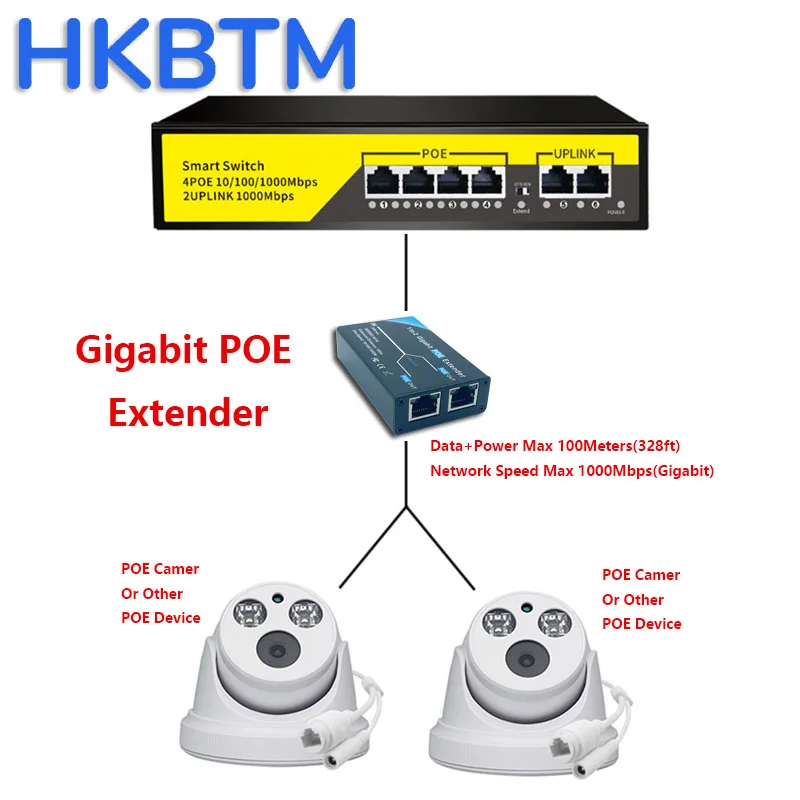
Plenty of useful endpoints - older IP cameras, Wi-Fi routers, thin clients, digital signage, and IoT controllers - need both network connectivity and DC power, but were never designed to accept power over the Ethernet cable. Running a separate AC outlet to a ceiling, pole, or remote wall is expensive and sometimes impossible. A PoE splitter removes that constraint by drawing power from the central switch or injector, allowing a 12 V device to sit up to 100 meters (about 328 feet) from any outlet.
How a PoE Splitter Works
Internally, a splitter behaves as a powered device (PD) on the network side. Its operation can be broken into a few stages:
- Input: A PoE-powered Ethernet cable plugs into the splitter's RJ45 input, carrying both data and a high DC voltage (nominally 48-56 V on standard systems).
- Negotiation (active splitters): An IEEE-compliant splitter presents the 25 kΩ detection signature and a classification signature so the PSE recognizes it as a valid PD and authorizes power.
- Separation: Internal circuitry splits the signal into two paths - a clean data path and a power path.
- Conversion: A DC-DC converter (typically a buck regulator) steps the ~48 V input down to a stable, regulated output such as 5 V, 9 V, 12 V, or 24 V.
- Output: Data exits on an RJ45 port to the device's network port, while regulated DC exits on a barrel jack or terminal to the device's power input.
Typical Output Voltages
| Output voltage | Typical loads |
|---|---|
| 5 V | Single-board computers, USB-powered IoT, small sensors |
| 9 V | Some routers, audio devices, specialty modules |
| 12 V | IP cameras, Wi-Fi routers/APs, small switches, signage players |
| 24 V | Industrial controllers, some PTZ cameras, certain access points |
Active vs Passive Splitters
An active, IEEE-compliant splitter performs the detection and classification handshake, so it works safely with standard 802.3af/at/bt switches and injectors. A passive splitter simply taps a fixed voltage that is already present on the line with no negotiation - it must be paired with a matching passive PoE source and the correct voltage, or it can damage equipment. For broad compatibility and safety, active splitters are the preferred choice in mixed B2B environments.
Common Use Cases
- Surveillance: Powering legacy 12 V IP cameras from a modern PoE switch without local outlets.
- Wireless: Feeding wall- or ceiling-mounted access points and routers that ship with a 12 V adapter.
- Digital signage and kiosks: Centralizing power for displays and media players in retail and transport hubs.
- IoT and edge devices: Bringing single-cable power and data to sensors, gateways, and controllers in hard-to-wire locations.
Why Not Just Use a Wall Adapter?
It is fair to ask why an installer would choose a splitter over a simple AC power adapter at the device. The answer is infrastructure economics. Running mains power to a ceiling, exterior wall, light pole, or factory gantry means hiring an electrician, pulling conduit, and often obtaining permits - per location. A PoE splitter instead reuses the structured cabling that already has to be there for data, drawing power from a switch that is typically in a secured, climate-controlled, and UPS-backed equipment room. That single change centralizes power, simplifies backup and monitoring, and removes dozens of failure-prone wall adapters scattered around a site.
Selecting and Deploying a Splitter
When specifying a splitter, confirm three things: the PoE standard of the upstream PSE (af/at/bt), the exact output voltage your device requires, and the current/wattage headroom needed. Also match the data rate - choose a gigabit splitter for 1000BASE-T links rather than a fast-Ethernet-only model. As a splitter manufacturer, we tailor output voltage, connector type, and power rating to the endpoint, so integrators can deploy a single cable run with confidence rather than improvising with mismatched adapters.
Need PoE hardware for your project?
Browse our PoE splitters or request a custom power module built to your spec.